


Greek Moussaka: Authentic Recipe, History & Cooking Guide
Greek Moussaka: More Than a Famous Greek Dish
Few dishes are as closely associated with Greek cuisine around the world as moussaka. With its layers of tender eggplant, rich meat sauce and creamy béchamel baked until beautifully golden, it is one of those dishes that can turn an ordinary meal into an occasion.
Yet Greek moussaka is more interesting than its international reputation might suggest.
It is not simply “eggplant, minced meat and béchamel.” Nor is there one single recipe followed identically in every Greek home. Families have their own preferences, cooks disagree about whether potatoes belong in the dish, and preparation methods vary from the traditional frying of the vegetables to lighter versions in which they are baked.
Understanding moussaka therefore means understanding both the recipe and the food culture surrounding it.
In Greece, moussaka is typically prepared as a large baked dish rather than as an individual portion. The layers are assembled in a baking tray, covered generously with béchamel and baked until the surface develops its characteristic golden colour. Once out of the oven, it needs something that impatient cooks often underestimate: time to rest.
That resting period is essential. A moussaka cut immediately after baking may collapse on the plate, while one allowed to settle can be divided into the tall, distinct slices for which the dish is famous.
This guide explores the complete story of Greek moussaka: what it is, how the modern Greek version developed, which ingredients matter most, how each layer should be prepared and how to avoid the mistakes that can turn an otherwise excellent moussaka watery, oily or difficult to slice.
Most importantly, it includes a practical traditional recipe that can actually be followed at home.
What is Greek Moussaka?
Greek moussaka is a layered oven-baked dish built around three principal elements:
- cooked eggplant, sometimes accompanied by potatoes,
- a richly seasoned minced-meat sauce,
- and a thick layer of béchamel on top.
The assembled dish is baked until the béchamel sets and develops a golden surface.
At first glance, the structure seems straightforward. In practice, however, the quality of a moussaka depends heavily on how each component is prepared before the dish ever reaches the oven.
Eggplant contains considerable moisture and readily absorbs oil. A meat sauce that is too liquid can make the finished dish unstable. Béchamel that is too thin will not create the substantial upper layer expected of Greek moussaka. Even the final resting time affects whether the portions hold their shape.
This is why good moussaka is less about complexity than about controlling moisture, texture and timing.
The layers of a traditional Greek moussaka
A typical moussaka may be assembled with:
A potato base – optional, but widely used
Thinly sliced potatoes can provide a firm foundation and absorb some of the juices released during baking.
Eggplant
The defining vegetable of the Greek version, prepared before assembly so that it becomes tender without making the finished dish excessively oily.
Minced-meat sauce
Usually cooked until concentrated rather than left with the loose consistency of a pasta sauce.
Béchamel
A generous final layer that sets during baking and creates the creamy contrast between the vegetables and meat underneath.
This combination produces the characteristic experience of moussaka: soft vegetables, concentrated savoury filling and a rich but delicate upper layer in a single slice.
But the moussaka recognised today as a classic of modern Greek cooking also has a history — and that history is considerably more interesting than the simple claim that the dish has remained unchanged since antiquity.
The History of Moussaka: From the Eastern Mediterranean to Modern Greece
Moussaka may be one of the most recognisable dishes of modern Greek cuisine, but its story does not begin with the neat layers of eggplant, minced meat and béchamel that most visitors to Greece know today.
Its history reflects something much broader: centuries of culinary exchange across the Eastern Mediterranean.
Versions of moussaka and related eggplant-based dishes developed across territories that were connected for centuries through trade, migration and the Ottoman Empire. Greece, Turkey, the Balkans and parts of the Middle East all developed dishes bearing the name moussaka – or closely related names – but their ingredients and cooking methods can differ considerably.
This makes the search for a single birthplace of moussaka difficult and, in many ways, misleading.
Food rarely respects modern national borders, particularly in a region where populations, ingredients and cooking traditions have travelled for centuries. What eventually became Greek moussaka should therefore be understood not as an isolated invention, but as a distinctly Greek interpretation of a wider Eastern Mediterranean culinary tradition.
The eggplant connection
Eggplant is central to that story.
Today it is difficult to imagine the cuisines of Greece and the Eastern Mediterranean without it. Eggplant appears in numerous Greek dishes and combines particularly well with other ingredients that define Mediterranean cooking: olive oil, tomato, onion, garlic, herbs and meat.
Its ability to absorb flavours also helps explain why it became such an effective foundation for moussaka.
When properly prepared, eggplant becomes soft and almost creamy while retaining enough structure to form a layer. When handled poorly, however, it can absorb excessive amounts of oil or release too much moisture – two problems that still determine whether a modern moussaka succeeds or fails.
The prominence of eggplant in Ottoman and Eastern Mediterranean cooking produced many celebrated dishes long before the modern Greek moussaka took its present form. That wider culinary tradition provided the environment from which different regional versions of moussaka could develop.
There is no single moussaka across the Mediterranean
One of the easiest mistakes to make is to assume that “moussaka” describes exactly the same dish everywhere.
It does not.
In Greece, the internationally familiar version is generally a substantial baked dish with layers of eggplant, meat sauce and béchamel. Potatoes are also common in many Greek household recipes.
Elsewhere in the Eastern Mediterranean and Balkans, dishes called moussaka may be prepared differently. The vegetables may change, the arrangement may be less strictly layered, and the thick béchamel topping that has become such a visual signature of Greek moussaka is not universal.
This distinction matters because it explains something important about Greek food culture: a dish can share roots, ingredients and even a name with neighbouring cuisines while developing a recognisable identity of its own.
Greek moussaka is an excellent example.
The turning point came in the 20th century
The moussaka served in Greek tavernas today should not be imagined as a dish that has existed in precisely the same form since ancient Greece.
Its defining transformation is much more recent.
During the early decades of the 20th century, Greek cooking was itself changing. Urban households were increasingly exposed to European – particularly French – culinary techniques, while Greek cooks and cookbook writers were beginning to codify recipes that had previously varied considerably from one household or region to another.
It was in this environment that one of the most influential figures in modern Greek culinary history entered the story: Nikolaos Tselementes.
His influence would help transform an Eastern Mediterranean dish centred on eggplant and meat into the structured, layered moussaka now recognised around the world as a classic of Greek cuisine.
And the ingredient that would make the difference was something that earlier regional versions did not necessarily possess:
béchamel.
Nikolaos Tselementes and the Moussaka We Know Today
To understand how the dish acquired its modern identity, we need to look at one of the most influential figures in 20th-century Greek cooking: Nikolaos Tselementes.
Born on the Cycladic island of Sifnos in 1878 and raised in Athens, Tselementes became much more than a successful chef and cookbook author. His work helped shape the direction of urban Greek cooking at a time when European culinary techniques – particularly those associated with French cuisine – were becoming increasingly influential.
He began publishing a cooking magazine in 1910 and later produced his celebrated Odigos Mageirikis (“Cooking Guide”). The book became so influential that his surname entered everyday Greek vocabulary: even today, Greeks may use the word tselementes when referring to a cookbook.
How béchamel changed the dish
Tselementes was strongly influenced by European cooking techniques and sought to introduce a more formal, structured style into Greek kitchens.
One of the most important results was the use of béchamel.
Earlier versions were considerably simpler and could consist of fried eggplant combined with meat and tomato, sometimes finished with cheese. The generous white topping that now seems inseparable from the familiar Greek version was a later development.
Béchamel changed much more than its appearance.
It introduced a completely different texture: soft and creamy above the more intensely flavoured layers underneath. When baked, the sauce forms a golden upper crust while remaining tender inside, giving each portion its characteristic contrast between vegetables, meat and creamy topping.
It also changed the structure of the finished dish. Instead of appearing primarily as a combination of cooked vegetables and meat, it became a substantial layered bake that could be rested, cut into tall portions and served as a complete main course.
A meeting of different culinary traditions
This transformation is one reason the dish tells such an interesting story about Greek cuisine itself.
Its components do not come from one isolated culinary tradition. Eggplant points toward the cooking cultures of the Eastern Mediterranean; tomato, olive oil, onions and aromatic spices reflect ingredients deeply integrated into regional cooking; while béchamel represents the European influence that became particularly visible in Greek urban cuisine during the early 20th century.
The result was not simply the replacement of one tradition by another.
Over time, these elements became so closely integrated that the finished dish developed an identity of its own – one that generations of Greek households subsequently adapted according to family taste, local ingredients and changing cooking habits.
That is also why searching for the single “original” recipe can be frustrating. Some cooks include potatoes; others do not. Some fry the eggplant, while others bake it. Meat choices and seasonings vary, and even the thickness and richness of the white sauce can differ considerably from one kitchen to another.
What remains remarkably consistent is the basic idea that emerged from this evolution: carefully prepared vegetables, a concentrated savoury meat layer and a generous creamy topping, assembled and baked as one dish.
That structure is the starting point for understanding the ingredients – and why the way each one is prepared matters just as much as the ingredient itself.
Traditional Greek Moussaka Ingredients: What You Really Need
A great result begins long before the baking dish goes into the oven. Each ingredient has a specific purpose, and understanding that purpose makes it much easier to control the texture, richness and balance of the finished dish.
The basic components are straightforward: eggplant, a well-reduced meat sauce, béchamel and, depending on the recipe, potatoes. Olive oil, tomato, onion, cheese and a restrained use of warm spices provide much of the flavour.
There is also room for variation. Greek household recipes are not identical, and choices such as including potatoes, using beef or another minced meat, or adjusting the spices often reflect family tradition and personal preference rather than a strict rule of authenticity.
Eggplant: the essential vegetable layer
Eggplant – or aubergine – is the vegetable most closely associated with the Greek version of the dish.
Its texture is particularly important. Once cooked properly, the slices become tender and almost creamy, absorbing the flavours around them while still providing enough structure to create distinct layers.
The challenge is that eggplant behaves almost like a sponge when exposed to oil. Frying can produce wonderful flavour and texture, but poorly controlled frying may leave the finished dish unnecessarily heavy.
Baking or roasting the slices with a controlled amount of oil offers a lighter alternative and is now common in home cooking.
Whichever method you choose, the objective is the same: the eggplant should be tender before assembly but not saturated with oil or wet enough to release excessive liquid during baking.
We will look at frying versus baking in more detail later in this guide.
Potatoes: traditional, optional or regional?
Potatoes deserve special attention because recipes frequently disagree about them.
Many Greek cooks use sliced potatoes as the bottom layer, while other versions rely primarily on eggplant. This is one of those cases where declaring one method “authentic” and everything else incorrect oversimplifies the way the dish is actually cooked in Greece.
A potato layer has practical advantages.
It creates a firm foundation, adds substance and can help absorb some of the juices from the layers above. This makes the final portions easier to lift from the baking dish while providing a pleasant contrast with the softer eggplant.
If potatoes are used, they should normally be at least partially cooked before assembly. Raw slices take considerably longer to soften and can remain unpleasantly firm even when the rest of the dish is ready.
So are potatoes essential?
No. But neither should they be dismissed as an inauthentic addition.
They are a well-established part of many Greek household versions, and whether to include them is ultimately a matter of recipe style and preference.
The meat: beef, lamb or a combination?
Outside Greece, lamb is often presented as the obvious choice for this dish. In practice, Greek recipes are more varied.
Minced beef is widely used, while some recipes call for lamb or a combination of meats. What matters more than insisting on one particular choice is the way the filling is prepared.
The meat needs to develop flavour and then simmer with the tomato and aromatics until the mixture becomes concentrated.
This is important.
The filling should not resemble a loose tomato sauce for pasta. Excess liquid trapped between the vegetable layers can make the finished dish watery and prevent clean slicing.
The ideal consistency is rich, moist and flavourful, but thick enough to remain where it is placed during assembly.
Tomato, onion and garlic
Tomato gives the meat filling acidity, sweetness and depth, while onion provides the aromatic foundation.
Garlic can also be used, although it should support rather than dominate the sauce.
Fresh ripe tomatoes can work beautifully when they are in season, while good-quality canned tomatoes provide consistency throughout the year. Tomato paste is particularly useful for intensifying flavour without introducing too much additional liquid.
Again, reduction matters more than quantity. A smaller amount of concentrated tomato flavour is preferable to a watery sauce.
Cinnamon, nutmeg and the question of spices
Warm spices are one of the subtle characteristics that distinguish the meat filling from an ordinary tomato-and-minced-meat sauce.
Cinnamon is particularly common, but restraint is important. It should provide warmth and aroma without making the filling taste sweet.
Depending on the household recipe, other seasonings may include cloves, allspice, bay leaf or a small amount of nutmeg.
Nutmeg is also traditionally associated with béchamel, where just a small quantity complements the milk, butter and cheese.
The goal is balance. No individual spice should overpower the eggplant, meat or creamy upper layer.
Olive oil
Olive oil naturally has an important place in the preparation, particularly when cooking the vegetables and building the meat sauce.
With eggplant, however, more is not necessarily better.
Because the slices can absorb considerable quantities of oil, good technique matters. Whether they are fried or baked, they should emerge tender and flavourful rather than dripping with fat.
This is one of the reasons draining fried vegetables properly – or carefully controlling the oil when roasting them – makes such a noticeable difference to the final result.
Cheese: flavour and a golden finish
A hard, flavourful cheese is commonly incorporated into the béchamel, sprinkled between layers or added to the surface before baking.
Greek cheeses such as kefalotyri are particularly well suited because their savoury character contrasts with the mild creaminess of the sauce.
The cheese should enhance the dish rather than turn the topping into a heavy cheese crust. Its most important roles are adding savoury depth and helping the surface develop an appetising golden finish in the oven.
Béchamel: the ingredient that brings everything together
The upper layer may look simple, but it is one of the most technically important parts of the entire recipe.
Butter, flour and milk form the basic sauce, while egg and grated cheese are often incorporated to produce the richer, firmer topping associated with the Greek preparation. Nutmeg provides subtle aromatic warmth.
Consistency is critical.
If the béchamel is too thin, it may seep into the layers underneath instead of remaining as a distinct creamy topping. If it is excessively thick, spreading it evenly becomes difficult and the finished texture can feel dense.
The ideal sauce should be smooth, rich and thick enough to remain on top when poured into the baking dish.
Getting that consistency right is one of the secrets behind the tall, creamy upper layer that makes a beautifully cut slice so distinctive.
Before making the béchamel, however, there is another ingredient that deserves much closer attention.
Eggplant may appear to be the simplest component of the recipe, but the way it is prepared can determine whether the finished dish is beautifully balanced or excessively oily and watery.
Eggplant: The Foundation of a Great Moussaka
Eggplant may look like one of the simplest ingredients in the recipe, but its preparation has a surprisingly large influence on the final result.
Too much oil can make the layers heavy and greasy. Too much moisture can leave liquid at the bottom of the baking dish. Slices that are too thin may almost disappear during cooking, while very thick pieces can dominate the texture and make neat portions more difficult to achieve.
The aim is simple: soft, flavourful slices that retain enough structure to form a layer without introducing unnecessary oil or water.
Choosing the right eggplants
Look for eggplants that feel firm and relatively heavy for their size, with smooth, glossy skin and no large soft or damaged areas.
Medium-sized vegetables are particularly convenient because they tend to produce manageable slices and are easy to arrange evenly in a baking dish.
Very large specimens can certainly be used, but their size may result in larger seeds and a more uneven internal texture.
The skin does not normally need to be removed. Once cooked, it softens considerably and helps the slices maintain some structure.
How thick should you slice the eggplant?
Consistency matters more than achieving an exact measurement.
As a practical guideline, slices around 8–10 mm thick work well. They are substantial enough to survive pre-cooking and assembly while still becoming completely tender in the finished dish.
Try to keep the thickness reasonably uniform.
If one slice is twice as thick as another, they will not cook at the same rate. Uniform slices make it much easier to create an even vegetable layer and ensure that every portion has a similar texture.
Eggplants can be cut lengthwise or into rounds depending on the shape of the baking dish and personal preference. Long slices are particularly useful when you want broad, continuous layers with fewer gaps.
Do you need to salt eggplant first?
Traditional preparation often involves salting the slices and leaving them to stand before cooking.
Historically, this was commonly associated with drawing out bitterness. Many modern varieties, however, are considerably less bitter than older ones, so salting is not always necessary for that reason alone.
It can still be useful.
Salt draws some moisture toward the surface and can slightly change the texture of the flesh. This can be helpful when preparing vegetables for a layered bake where controlling excess moisture is important.
To use this method, lightly salt the slices and leave them for approximately 20–30 minutes. Moisture will begin appearing on the surface.
Pat them thoroughly dry before cooking.
That final step matters. The objective is to remove moisture, not introduce additional water immediately before the slices go into hot oil or the oven.
Frying the eggplant: the traditional approach
Frying creates deeply flavoured, silky slices and remains a classic preparation method.
The disadvantage is obvious: eggplant absorbs oil extremely easily.
For better results, the oil should be properly heated before the slices are added. Cooking them in oil that is not hot enough encourages them to absorb more fat while they slowly soften.
Avoid overcrowding the pan as well. Adding too many slices at once lowers the temperature and makes even cooking more difficult.
Once tender and lightly coloured, transfer them to absorbent paper or a rack and allow excess oil to drain before assembly.
This small step can make an enormous difference.
Remember that the vegetables will later be combined with meat sauce and a rich creamy topping. They need enough olive oil for flavour and texture, but they do not need to carry unnecessary fat into the final bake.
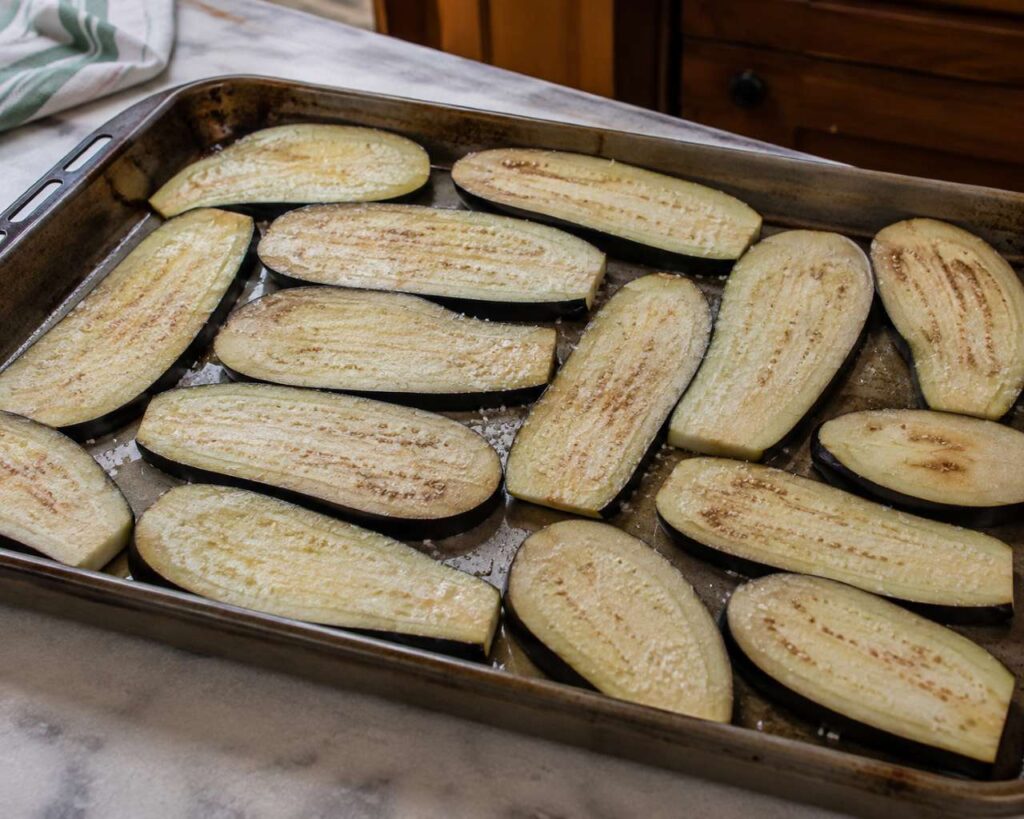
Baking the eggplant: an easier, lighter alternative
Baking or roasting is particularly practical when preparing a large quantity.
Arrange the slices in a single layer on baking trays, brush or lightly coat them with olive oil and cook until softened and lightly coloured, turning if necessary.
The major advantage is control.
Instead of allowing the flesh to absorb oil directly from a frying pan, you decide approximately how much oil reaches each slice. It also allows several portions to cook simultaneously, which can save considerable time.
The texture will not be exactly identical to fried eggplant, but the method works extremely well for home cooking and produces a noticeably lighter result.
Frying vs baking: which method is better?
There is no universal answer.
Choose frying if:
- you want the richer texture associated with traditional preparation;
- you do not mind working in batches;
- and you are prepared to drain the slices carefully.
Choose baking if:
- you want to reduce the amount of oil;
- you are cooking a large batch;
- or you prefer a simpler preparation with less work at the stove.
Both methods can produce an excellent result.
What matters much more is avoiding two extremes: eggplant that is still firm and undercooked, and slices so saturated with oil that they make the entire dish feel heavy.
Should the eggplant be fully cooked before layering?
It should be almost completely tender.
The final baking stage brings all the components together, but it should not be expected to cook thick raw eggplant from scratch.
This is an important distinction because the different layers have already undergone much of their cooking before assembly. The meat filling has been reduced, the vegetables have softened and the béchamel has been prepared separately.
The oven’s final job is largely to set the structure, combine the flavours and brown the surface.
The moisture test before assembly
Before you begin layering, look at the cooked slices.
They should bend easily without disintegrating. Their surfaces should not be swimming in oil, and there should not be obvious pools of water around them.
If they were fried, give them sufficient time to drain.
If they were baked and appear wet, allow some of the steam to escape before placing them in the baking dish.
These small decisions are far more important than they may seem. A little excess liquid from each individual component can become a considerable amount once everything is assembled.
And that leads to one of the fundamental principles behind a successful layered bake:
control the moisture in each component before the layers come together, rather than trying to fix a watery dish after it comes out of the oven.
With the eggplant ready, attention can turn to the layer responsible for most of the dish’s savoury depth: the slow-cooked, concentrated meat sauce.
The Moussaka Meat Sauce: Rich, Aromatic and Properly Reduced
The meat sauce is the savoury heart of a traditional Greek moussaka. It provides depth, aroma and richness between the tender eggplant and creamy béchamel, but its texture is just as important as its flavour.
A good moussaka meat sauce should be concentrated rather than wet.
This is one of the key differences between preparing meat sauce for moussaka and making a typical sauce for pasta. With pasta, a relatively loose sauce is rarely a problem. Inside a layered baked dish, however, excess liquid has nowhere to go. It can seep into the vegetables, collect at the bottom of the baking dish and make the finished portions collapse when cut.
The objective is therefore a filling that remains moist and succulent while being thick enough to hold its position between the layers.
Choosing the meat for Greek moussaka
Minced beef is a very common and practical choice in Greek home cooking. Lamb can also be used, as can a combination of meats, depending on personal preference and family tradition.
The idea that authentic Greek moussaka must always contain lamb is too restrictive.
What matters considerably more is the quality of the meat and how it is cooked.
A mince containing some fat generally produces better flavour and texture than an extremely lean version. At the same time, excessive fat should not be allowed to accumulate in the pan, because the finished dish already contains olive oil, cheese and a rich béchamel topping.
Balance is the goal.
Start by building an aromatic base
Begin with finely chopped onion cooked gently in olive oil until softened.
This creates the aromatic foundation of the sauce and allows the natural sweetness of the onion to develop before the meat is added.
Garlic may follow, but avoid cooking it aggressively. Burnt garlic introduces bitterness that becomes particularly noticeable after the sauce has reduced.
Once the aromatics are ready, add the minced meat and break it apart thoroughly with a wooden spoon.
Do not simply allow the meat to steam in its own liquid.
Give it enough heat and space to lose its raw colour and develop some browning. Browning creates deeper savoury flavours that remain noticeable even after the tomato, spices and other ingredients are introduced.
If you are cooking a particularly large quantity, using a sufficiently wide pan can make this much easier.
Tomato should add flavour, not water
Tomato is essential to the character of the filling, but more tomato does not automatically mean more flavour.
For moussaka, concentration is more valuable than volume.
Good-quality chopped or crushed tomatoes work well, while tomato paste can provide additional depth without adding much liquid. If fresh tomatoes are used, especially very juicy summer tomatoes, the sauce may simply require longer cooking to reach the correct consistency.
After adding the tomato, allow the filling to simmer uncovered so that excess moisture can evaporate.
This reduction stage should not be rushed.
A sauce that appears perfect while bubbling in the pan can still be too wet for layering. Remember that it will later be enclosed between vegetables and béchamel, where evaporation becomes much more limited.
The spices that give moussaka its distinctive aroma
One of the pleasures of Greek moussaka is the subtle warmth behind the savoury meat and tomato.
Cinnamon is frequently used for this purpose.
The important word is subtle.
You should notice an aromatic warmth rather than an obvious cinnamon flavour. Too much can quickly dominate the meat and give the sauce an unexpectedly sweet character.
Depending on the recipe, the filling may also contain bay leaf, cloves or allspice. A small amount of wine may be added and allowed to reduce before the tomatoes go into the pan.
These variations are part of the reason one family’s moussaka may smell and taste slightly different from another’s.
There is no need to use every possible spice. A restrained combination usually produces a more balanced result than a long list of competing aromas.
Should you add wine?
Wine is optional, but it can contribute additional complexity.
If using it, add the wine after the meat has browned and allow it to reduce before adding the tomatoes. This gives the alcohol time to evaporate while leaving its aromatic character behind.
Red wine can provide a deeper flavour, although individual recipes and household traditions vary.
The important point is again moisture control: wine should be reduced, not simply poured into the sauce shortly before assembly.
How long should the meat sauce cook?
Rather than relying entirely on the clock, watch the consistency.
The sauce should gradually become darker, richer and thicker as it simmers. When you draw a spoon across the bottom of the pan, liquid should not immediately flood into the space.
The meat should remain moist, but there should be no pool of thin tomato liquid surrounding it.
For a successful moussaka, this visual test is more useful than following an exact cooking time because tomatoes, meat, cookware and heat levels all vary.
Taste the sauce before removing it from the heat.
Once it becomes part of the assembled dish, adjusting the seasoning is impossible. This is the moment to check the salt, pepper and spices and decide whether the flavours are properly balanced.
Let the filling cool before assembling
There is another small step that can significantly improve the layering process: do not assemble everything while the meat sauce is furiously hot.
Allowing it to cool slightly makes it thicker and easier to distribute evenly over the vegetables.
This also helps prevent the different components from immediately releasing steam and moisture into one another before the baking dish even enters the oven.
You do not need to refrigerate the sauce or wait until it is completely cold. It simply needs a little time to settle.
How do you know when the moussaka meat sauce is ready?
Before you begin layering, look for four things:
- Concentration: there should be no obvious watery liquid in the pan.
- Texture: the minced meat should remain juicy rather than dry.
- Aroma: tomato and spices should complement the meat rather than overpower it.
- Seasoning: the sauce should already taste complete on its own.
If all four are in place, you have created a filling capable of supporting the layers above it rather than destabilising them.
This principle is fundamental to making moussaka that holds its shape. Each component needs to be prepared correctly before assembly. The oven can bring those components together, but it cannot remove large quantities of moisture trapped inside them without affecting the texture of the entire dish.
With the eggplant prepared and the meat sauce properly reduced, we arrive at the component that gives Greek moussaka its unmistakable top layer: a thick, smooth and beautifully golden béchamel.
The Béchamel: What Makes Greek Moussaka Distinctive
The thick layer of béchamel is one of the features that makes Greek moussaka immediately recognisable.
Eggplant and seasoned meat appear in several dishes across the Eastern Mediterranean, but the generous creamy topping gives modern moussaka its distinctive appearance, texture and character. Once baked, the béchamel develops a golden surface while remaining soft and creamy underneath, creating a striking contrast with the darker meat sauce and tender vegetables below.
For many people, this is the layer that transforms moussaka from a simple combination of vegetables and meat into one of the most memorable dishes of Greek cuisine.
But good béchamel requires the right consistency.
Too thin, and it may run into the layers below. Too thick, and it becomes difficult to spread and can produce a dense topping. For Greek moussaka, the ideal béchamel needs enough body to remain as a distinct layer while still feeling smooth and creamy when eaten.
What is moussaka béchamel made from?
The foundation is a classic white sauce made with:
- butter,
- flour,
- milk,
- eggs,
- grated cheese,
- and usually a small amount of nutmeg.
utter and flour are first cooked together to create a roux. Milk is gradually incorporated to form a smooth sauce. The Greek preparation used for moussaka is then commonly enriched with egg and cheese, giving it greater flavour and helping it set during baking.
The result should be noticeably thicker than a light white sauce intended simply to coat vegetables or pasta.
That thickness is essential to the characteristic structure of Greek moussaka.
Start with the roux
Melt the butter over moderate heat and add the flour, stirring continuously.
The purpose is to combine the fat and flour completely while cooking away the raw flour taste. You are not trying to produce a dark roux. The mixture should remain relatively pale.
Cook it gently for a short period while stirring.
This simple foundation determines how smoothly the milk will incorporate later, so take the time to remove obvious lumps before moving on.
Add the milk gradually
One of the most common béchamel problems is lumping.
The easiest way to reduce the risk is to add the milk gradually while whisking continuously. Begin with a relatively small quantity and incorporate it fully before adding more.
As additional milk enters the pan, the mixture will loosen and eventually become a smooth sauce.
Continue cooking and stirring as it thickens.
For moussaka béchamel, stop thinking of the sauce as ready simply because it coats the back of a spoon. It needs sufficient body to form a substantial upper layer.
When you lift the whisk, the sauce should fall back slowly rather than pour like milk or cream.
How thick should béchamel be for moussaka?
This is one of the most important practical questions in the entire recipe.
The béchamel should be thick, smooth and spreadable.
It should not be so stiff that you have to force it across the meat layer, but it should not immediately level itself into a thin liquid either.
Remember what happens next: the sauce will sit on top of the assembled moussaka, enter a hot oven and soften again before the eggs and flour help it set.
Starting with an excessively thin béchamel makes it much harder to achieve the tall creamy layer associated with a well-made Greek moussaka.
Why are eggs added?
Eggs help enrich the béchamel and contribute to its structure as it bakes.
There is one important precaution: avoid adding eggs directly to extremely hot sauce.
Remove the béchamel from the strongest heat and allow it to cool slightly first. Depending on the method, some warm sauce can also be gradually mixed into the beaten eggs before they are incorporated into the main pan.
The objective is to raise their temperature gently rather than scramble them.
Once incorporated correctly, the eggs help the moussaka topping set sufficiently to hold its shape when sliced while retaining a soft interior.
Cheese adds savoury depth
Grated cheese brings saltiness, richness and another layer of flavour to the béchamel.
Kefalotyri is an excellent Greek choice where available. Other firm, flavourful cheeses can also be used depending on availability and the recipe being followed.
Some cooks incorporate cheese directly into the sauce, while others also sprinkle a little over the surface before baking.
Either way, moderation matters.
The béchamel should still taste like a creamy sauce rather than melted cheese. In a balanced moussaka, no single component should overwhelm the others.
Don’t forget the nutmeg
A small amount of nutmeg is a classic addition to béchamel.
It works particularly well with milk, butter and cheese and gives the sauce a subtle warmth that complements the spices in the meat layer.
As with cinnamon in the meat sauce, restraint is essential.
Nutmeg should sit quietly in the background. If it is the first flavour you notice when tasting the béchamel, you have probably used too much.
How to prevent lumps in moussaka béchamel
A few simple habits make a major difference:
- incorporate the flour completely into the butter;
- add the milk gradually rather than all at once;
- whisk continuously, particularly during the early stages;
- control the heat so the bottom does not scorch;
- and do not wait until the sauce becomes extremely thick before trying to correct its texture.
If small lumps appear early, vigorous whisking may still remove them.
A smooth béchamel matters visually as well as texturally. The top of a properly baked Greek moussaka should look creamy and even rather than rough or broken.
Why does béchamel sometimes become too runny?
Several things can cause a thin topping.
Too much milk relative to the flour and butter is the obvious possibility, but insufficient cooking can also be responsible. The flour needs heat and time to thicken the liquid properly.
Another common mistake is judging the consistency too early.
If the sauce is still visibly fluid, continue cooking gently while whisking and reassess it after it thickens.
Trying to compensate for very runny béchamel by simply pouring it onto the moussaka and hoping the oven will fix it is risky. The better approach is to achieve the correct consistency before assembly.
Why does béchamel sometimes become too thick?
The opposite problem can occur if the sauce cooks for too long or contains too much flour.
An excessively thick béchamel can be difficult to spread without disturbing the meat layer underneath. It may also produce a heavy, floury texture after baking.
If the sauce becomes too thick before the eggs are added, a little additional milk can usually loosen it.
Add only a small quantity at a time.
It is much easier to adjust the consistency gradually than to rescue a sauce that has suddenly become too thin.
The secret is balance
A beautiful slice of moussaka should reveal clearly defined layers, and the béchamel should be substantial enough to be one of them.
But thickness alone is not the goal.
The best Greek moussaka combines contrasts: tender eggplant, savoury meat, aromatic tomato and spices, and a creamy topping with enough structure to remain intact on the plate.
The béchamel therefore has two jobs.
It must be firm enough to hold and soft enough to eat like a cream.
Achieving both is one of the small technical details that separates an ordinary moussaka from an excellent one.
Once the eggplant, meat sauce and béchamel are ready, all the major components have been prepared separately.
Now comes the moment when they finally become one dish: assembling the moussaka in the correct order, baking it until golden, and – just as importantly – knowing when not to cut it.
How to Make Greek Moussaka Step by Step
Now that we have looked closely at the individual components, it is time to bring them together into a complete Greek moussaka recipe.
This version makes approximately 8 generous servings and is designed for a baking dish around 23 × 33 cm / 9 × 13 inches.
The preparation becomes much easier if you think of the recipe as four separate jobs: prepare the vegetables, cook and reduce the meat sauce, make the béchamel, and finally assemble and bake the moussaka.
Ingredients for the vegetables
- 3 large eggplants, approximately 1.2–1.4 kg / 2.6–3 lb
- 2–3 medium potatoes, approximately 500–600 g / 1.1–1.3 lb, optional
- Extra virgin olive oil, as needed
- Salt
Ingredients for the meat sauce
- 750 g / 1.65 lb minced beef
- 1 large onion, finely chopped
- 2 garlic cloves, finely chopped or crushed
- 2 tablespoons extra virgin olive oil
- 2 tablespoons tomato paste
- 400 g / 14 oz chopped or crushed tomatoes
- 120 ml / ½ cup dry red wine, optional
- 1 bay leaf
- ½ teaspoon ground cinnamon
- A small pinch of ground cloves or allspice, optional
- Salt and freshly ground black pepper
Ingredients for the béchamel
- 100 g / 3.5 oz butter
- 100 g / 3.5 oz all-purpose flour
- 1 litre / 4¼ cups whole milk
- 2 eggs
- 80–100 g / 3–3.5 oz grated kefalotyri or another firm cheese
- Freshly grated nutmeg
- Salt and freshly ground black pepper
Step 1: Prepare the eggplant
Wash the eggplants and remove the stems.
Cut them lengthwise into slices approximately 8–10 mm thick.
Lightly salt the slices and leave them for around 20–30 minutes before cooking. This traditional step is particularly useful with eggplants that have a noticeable bitterness, while also helping draw out excess moisture.
Small droplets will gradually appear on the surface.
Pat the eggplant thoroughly dry with kitchen paper or a clean kitchen towel before cooking.
For the traditional method, fry the slices in batches until softened and lightly coloured. Transfer them to absorbent paper or a rack so that excess oil can drain away.
For a lighter alternative, arrange the slices on baking trays, brush them lightly with olive oil and bake at approximately 200°C / 400°F until tender and lightly browned.
Whichever method you choose, the eggplant should be soft and almost completely cooked while still holding its shape.
Best Tip: Salt the Eggplant Before Cooking
When preparing Greek moussaka, do not rush the eggplant. Salting the slices before cooking is a traditional step that is well worth the extra time, particularly when using Greek eggplants, which can have a noticeable bitterness.
Place the sliced eggplant in a colander or on a large tray, sprinkle both sides with salt and leave it to rest for approximately 20–30 minutes.
As the eggplant rests, the salt helps draw out some of its bitter juices along with excess moisture. Small droplets will gradually appear on the surface.
After resting, pat the slices thoroughly dry with kitchen paper or a clean kitchen towel before frying or baking them.
This step is important for two reasons. First, it helps reduce any unwanted bitterness in the eggplant. Second, removing excess moisture helps prevent the finished moussaka from becoming watery and makes it easier to achieve well-defined layers.
For the best Greek moussaka: salt the eggplant, allow it to rest, dry it thoroughly, and only then fry or bake the slices before assembling the dish.
It takes an extra 20–30 minutes, but it is one of those small traditional techniques that can make a noticeable difference to the final flavour and texture.
Step 2: Prepare the potatoes
If you are including potatoes, peel them and cut them into slices approximately 5–7 mm thick.
They can be lightly fried in olive oil or brushed with oil and baked until partially cooked.
Do not leave them completely raw before assembly. Moussaka contains several dense layers, and thick raw potato slices may not become sufficiently tender by the time the rest of the dish is ready.
The potatoes should be flexible and partly cooked but still firm enough to form a stable bottom layer.
Step 3: Cook the meat sauce
Heat the olive oil in a large pan over medium heat.
Add the chopped onion and cook until softened. Add the garlic and cook briefly, taking care not to burn it.
Add the minced beef and increase the heat slightly.
Break the meat apart with a wooden spoon and cook until it has lost its raw colour and begins to brown.
Stir in the tomato paste and cook it briefly with the meat.
If using wine, add it now and allow it to reduce before adding the tomatoes.
Add the chopped tomatoes, bay leaf, cinnamon and, if desired, a very small pinch of clove or allspice. Season with salt and black pepper.
The cinnamon should remain subtle. Its purpose is to give the filling warmth and aromatic depth, not to make the sauce taste predominantly of cinnamon.
Simmer uncovered for approximately 25–35 minutes, stirring occasionally.
By the end of cooking, the sauce should be thick and concentrated. Drag a spoon across the bottom of the pan: the liquid should not immediately flood back into the space.
Remove the bay leaf and allow the filling to cool slightly while you prepare the béchamel.
Step 4: Make the béchamel
Melt the butter in a saucepan over medium-low heat.
Add the flour and whisk continuously to form a smooth roux. Cook briefly without allowing it to become dark.
Begin adding the milk gradually, whisking constantly.
Do not pour in all the milk at once. Allow each addition to incorporate smoothly before adding more.
Continue cooking and whisking until the sauce becomes thick enough to coat the whisk and fall back into the saucepan in broad ribbons.
Remove the pan from the heat.
In a separate bowl, lightly beat the eggs. Temper them by gradually whisking in a small amount of the hot béchamel.
Once the eggs have warmed gradually, whisk the mixture back into the saucepan.
Add most of the grated cheese, a little nutmeg, salt and black pepper.
The finished béchamel should be thick, smooth and spreadable rather than runny.
Step 5: Assemble the moussaka
Lightly grease the baking dish.
If using potatoes, arrange them across the bottom in an even layer.
Add a layer of cooked eggplant, overlapping the slices slightly where necessary so that there are no large gaps.
Spread the meat sauce evenly over the vegetables.
Depending on the amount of eggplant and the depth of your dish, you can add another layer of eggplant over the meat.
Finally, spoon the béchamel over the entire surface.
Spread it gently from edge to edge without pressing it into the meat layer.
Sprinkle the remaining grated cheese over the top.
The final order will therefore be:
Potatoes, if using → eggplant → meat sauce → optional additional eggplant → béchamel → grated cheese.
Step 6: Bake until golden
Preheat the oven to 180°C / 350°F.
Place the assembled moussaka on the middle rack and bake for approximately 40–50 minutes.
The exact time will depend on the depth of the baking dish and the temperature of the components when assembled.
The moussaka is ready when the béchamel has set, the surface is golden and you can see gentle bubbling around some of the edges.
If the top begins browning too quickly, cover it loosely with foil and continue baking until the centre is properly heated.
Step 7: Let the moussaka rest
Remove the baking dish from the oven — and resist the temptation to cut it immediately.
Allow the moussaka to rest for at least 30–45 minutes.
This is not merely waiting for the dish to become cool enough to eat.
The resting period allows the meat sauce, vegetables and béchamel to settle and become more stable. Cutting too early is one of the most common reasons a perfectly good moussaka collapses onto the plate.
Step 8: Cut and serve
Once rested, cut the moussaka into generous squares or rectangular portions.
A properly prepared slice should hold together while still remaining tender inside. You should be able to see the vegetable layer, concentrated meat filling and thick béchamel rather than having them run together on the plate.
Serve the moussaka warm rather than piping hot.
Greek Moussaka Cooking Time at a Glance
Preparation: approximately 45–60 minutes
Meat sauce: approximately 25–35 minutes
Baking: approximately 40–50 minutes
Resting: at least 30–45 minutes
Servings: approximately 8 generous portions
The recipe involves several stages, but none of them is particularly difficult on its own.
The real secret is not speed. It is making sure that each component has the correct texture and moisture level before the moussaka goes into the oven.
Once the ingredients are ready, the next challenge is assembling them correctly – because the order and thickness of the layers can make the difference between a firm, elegant slice and a moussaka that falls apart on the plate.
How to Layer Moussaka Correctly
Once the vegetables, meat sauce and béchamel are ready, assembling the moussaka may seem like the easiest part of the recipe.
In many ways it is.
But good layering is about more than simply placing one ingredient on top of another. The thickness and distribution of each component affect how evenly the dish cooks, how well it holds together and what each forkful tastes like.
The goal is balance.
No single layer should overwhelm the others.
Start with a stable base
If you are using potatoes, arrange them across the bottom of the baking dish in a relatively even layer.
Slight overlapping is fine, but avoid building unnecessarily thick areas.
The potatoes create a firm foundation for the rest of the moussaka and can absorb some of the juices released during baking.
Because they sit at the bottom of a heavy layered dish, they should already be partially cooked before assembly.
If you are making moussaka without potatoes, begin directly with the eggplant.
Arrange the eggplant without compressing it
Place the cooked eggplant slices across the dish, overlapping them slightly where necessary to avoid large gaps.
The aim is to create a continuous vegetable layer without packing the slices together too tightly.
Remember that properly prepared eggplant is already soft.
Pressing or compressing it unnecessarily can release additional oil or moisture and make the layer dense.
If you have enough eggplant for two layers, reserve some slices for the layer above the meat sauce.
Spread the meat sauce evenly
Spoon the reduced meat filling over the eggplant and distribute it across the entire baking dish.
Try to maintain approximately the same thickness from one end of the dish to the other.
Do not press the meat aggressively into the eggplant.
The sauce should sit as its own distinct layer.
This is also the moment when the consistency of the filling becomes particularly important.
If liquid begins collecting around the vegetables as you spread the meat, the sauce was probably not reduced sufficiently.
A properly prepared filling should be moist and rich but thick enough to remain where you place it.
Add a second eggplant layer if desired
Some versions of Greek moussaka place all the eggplant underneath the meat filling.
Others include another layer above it.
Both approaches can work.
A second eggplant layer creates a stronger vegetable presence and separates the meat filling from the béchamel more clearly.
If you use one, arrange the slices gently over the meat rather than pressing them down.
Finish with a generous layer of béchamel
The béchamel should form a clearly visible upper layer.
Spoon it across the surface in several places before beginning to spread it. This is easier than placing all the sauce in the centre and pushing it outward.
Use a spatula or the back of a spoon to guide the béchamel gently toward the edges.
Avoid repeatedly mixing the surface, as this can pull meat sauce into the white topping.
Once evenly distributed, finish with grated cheese.
At this point, the moussaka should have a clearly defined structure:
potatoes, if using → eggplant → meat sauce → optional second eggplant layer → béchamel → cheese.
The dish is now ready for the oven.
Baking Temperature: How to Get a Golden Moussaka
Bake the assembled moussaka at approximately 180°C / 350°F.
For a standard 23 × 33 cm / 9 × 13 inch baking dish, approximately 40–50 minutes is usually sufficient.
Treat that time as a guide rather than an absolute rule.
A moussaka assembled from warm components may cook somewhat faster than one that has been prepared in advance and refrigerated.
The depth and material of the baking dish can also affect the cooking time.
What should moussaka look like when it is ready?
Look for several signs rather than relying only on the clock.
The béchamel should appear set rather than liquid.
The centre should be thoroughly heated.
There may be gentle bubbling around some of the edges.
Most importantly, the surface should have developed an attractive golden colour, with slightly darker areas where the cheese has browned.
The goal is golden, not burnt.
Where should moussaka sit in the oven?
The middle rack is generally the safest position.
Placing the dish too close to the upper heating element can brown the béchamel before the centre has had enough time to heat properly.
If the surface is colouring too quickly, cover the baking dish loosely with foil.
Continue baking until the centre is ready, then remove the foil toward the end if the surface needs a little more colour.
How do you know when moussaka is fully cooked?
Because the vegetables and meat sauce have already been cooked before assembly, baking is primarily about bringing the entire dish together and setting the béchamel.
The centre should be thoroughly hot and the topping should no longer move like a liquid when the baking dish is handled carefully.
A golden surface alone is not enough.
If the moussaka has been assembled cold, give the centre sufficient time to heat before removing the dish from the oven.
And once it does come out, the cooking may be finished – but the recipe is not.
Why You Should Never Cut Moussaka Straight from the Oven
Few things are more tempting than cutting through the golden béchamel immediately after the moussaka leaves the oven.
It is also one of the easiest ways to ruin the presentation of an otherwise excellent dish.
Fresh from the oven, everything inside is extremely hot.
The vegetable layers are soft, the meat filling is still loose from the heat and the béchamel has not yet had sufficient time to settle.
Cut into it immediately and the layers can slide apart, releasing juices across the plate.
The solution is simple:
wait.
How long should moussaka rest?
Allow the finished moussaka to rest for at least 30–45 minutes before cutting it.
For a particularly deep baking dish, a little longer can be beneficial.
During this period, the temperature gradually falls and the layers become more stable.
The moussaka will still be warm when served, but it will be dramatically easier to portion.
Should moussaka be served piping hot?
No.
Moussaka is generally at its best warm rather than aggressively hot.
Apart from making the layers easier to distinguish, allowing the dish to cool slightly also makes its flavours easier to appreciate.
A mouthful of extremely hot béchamel and meat sauce hides much of the subtlety that went into preparing them.
The three secrets to clean moussaka slices
A slice that stands neatly on the plate is usually the result of three things working together:
Moisture control: the eggplant is properly prepared and the meat sauce sufficiently reduced.
Structured béchamel: the topping is thick enough and has set correctly during baking.
Resting time: the finished dish is given enough time to settle before cutting.
The resting period cannot compensate completely for a watery meat sauce or poorly prepared vegetables, but even a perfectly assembled moussaka needs it.
This is why presentation is not something that happens only at the moment of serving.
It begins much earlier, with controlling moisture in every component and continues all the way through the final rest.
A watery base, oily eggplant, runny béchamel or collapsing slices usually have identifiable causes – and, more importantly, they can almost always be prevented.
Why Moussaka Falls Apart: Common Mistakes and How to Fix Them
A good moussaka should be tender and creamy, but it should also have enough structure to hold together when served.
When something goes wrong, the problem is rarely the entire recipe.
Usually, one component contains too much moisture, has the wrong consistency or has not been cooked sufficiently before the dish is assembled.
Understanding the cause makes most moussaka problems surprisingly easy to prevent.
1. The moussaka is watery
This is probably the most common problem.
Moussaka contains several ingredients capable of releasing moisture: eggplant, potatoes, tomatoes and meat sauce. If too much liquid enters the baking dish, it eventually collects at the bottom or between the layers.
The solution begins long before baking.
Salt and dry the eggplant properly, particularly when working with varieties that contain considerable moisture. Cook the slices until tender and allow excess oil or liquid to drain.
The meat sauce must also be properly reduced.
It should be thick enough to remain in place when spread over the vegetables rather than behaving like a pasta sauce.
Finally, allow the baked moussaka to rest before cutting it. Some of the apparent “wateriness” of a freshly baked dish is simply the result of slicing it while every component is still extremely hot.
2. The eggplant is too oily
Eggplant behaves like a sponge when fried.
If the oil is not hot enough, or if the slices remain in the pan unnecessarily long, they can absorb far more fat than required.
Fry in batches rather than overcrowding the pan and allow the cooked slices to drain thoroughly afterward.
You can also bake the eggplant with a controlled amount of olive oil if you prefer a lighter result.
The goal is soft, flavourful eggplant – not slices saturated with oil.
3. The meat sauce is too runny
A loose meat filling is one of the fastest routes to collapsing moussaka.
The tomato and meat mixture needs time to reduce before assembly.
Cook it uncovered toward the end so that excess liquid can evaporate.
To test the consistency, drag a spoon across the bottom of the pan.
If watery liquid immediately fills the space, continue cooking.
The finished sauce should remain moist but should look concentrated and cohesive, with very little free liquid.
Do not rely on the oven to reduce a watery filling after the moussaka has already been assembled.
By then, that moisture has nowhere useful to go.
4. The béchamel is too thin
Moussaka béchamel should be substantially thicker than a light sauce intended for pouring over vegetables or pasta.
If it is too thin, it may seep into the meat layer instead of remaining as a distinct topping.
Cook the roux properly, add the milk gradually and give the sauce enough time to thicken.
The eggs and cheese added later will help it set during baking, but they cannot completely rescue a béchamel that begins with far too much liquid.
Before assembly, the sauce should be thick enough to spread across the surface rather than run across it.
5. The béchamel contains lumps
Lumps usually form when milk is added too quickly to the roux or when the mixture is not whisked sufficiently.
Add the milk gradually while whisking continuously, particularly during the first additions.
Once the base has become smooth, the remaining milk can be incorporated more easily.
If a few small lumps appear, vigorous whisking may remove them.
For stubborn lumps, passing the sauce through a fine sieve can rescue the texture before the eggs and cheese are added.
6. The eggplant is still firm
The oven is not the place to cook completely raw eggplant hidden beneath several dense layers.
The slices should already be almost fully tender before assembly.
Whether fried or baked, they need enough preliminary cooking to soften properly.
If the eggplant remains noticeably firm when you begin layering, cook it longer.
The final baking stage should bring the components together, not compensate for undercooked vegetables.
7. The potatoes are undercooked
The same principle applies to potatoes.
Raw or very thick potato slices placed at the bottom of the dish may remain unpleasantly firm even after the béchamel has browned.
Slice them approximately 5–7 mm thick and partially cook them before assembly.
They can be lightly fried or baked until they begin to soften.
The finished potato layer should be tender enough to cut easily with the rest of the moussaka.
8. The top browns before the centre is ready
This can happen when the baking dish is placed too high in the oven, the upper heating element is particularly strong or the moussaka was very cold when it went into the oven.
Move the dish to the middle rack and cover the surface loosely with foil once it has developed enough colour.
The foil protects the béchamel while allowing the centre to continue heating.
Remove it toward the end if the surface needs additional browning.
Do not assume that a golden top automatically means the entire moussaka is ready.
9. The moussaka collapses when sliced
If the individual components were prepared correctly but the slice still collapses, ask one question first:
How long did you wait before cutting it?
Moussaka needs at least 30–45 minutes of resting time after baking.
Straight from the oven, the filling is extremely hot and the layers are at their least stable.
As the dish rests, the structure firms and the juices settle.
If you want particularly clean portions for guests, patience is more effective than trying to make the recipe excessively dry.
10. The moussaka tastes too strongly of cinnamon
Cinnamon should provide warmth in the background of the meat sauce.
It should not be the first flavour you notice.
The safest approach is restraint.
For approximately 750 g of minced meat, around ½ teaspoon of ground cinnamon is generally enough for a noticeable but balanced aromatic character.
Alternatively, a cinnamon stick can be simmered with the sauce and removed before assembly.
Clove and allspice should be used even more carefully.
These spices are powerful, and adding more does not make the dish more authentically Greek.
11. The finished dish feels too heavy
Moussaka is naturally substantial, but it should not feel overwhelmingly greasy.
Several small choices can make a significant difference.
Allow fried eggplant and potatoes to drain thoroughly. Do not use more oil than necessary in the meat sauce. Reduce the filling properly rather than relying on fat to create richness.
Baking the vegetables instead of frying them can also produce a lighter version.
Most importantly, remember that richness should come from the combination of flavours and textures, not simply from adding more fat to every component.
12. The layers slide apart
Sliding layers usually indicate a combination of excess moisture and insufficient resting.
Check that the eggplant has been drained, the meat sauce is thick and the béchamel has enough structure.
When assembling, spread each component evenly but avoid pressing the layers together aggressively.
Then allow the baked dish to rest.
The layers do not need to be compressed to stay together. They need the correct consistency.
Can you fix a watery moussaka after baking?
Once the dish has been baked, there is no perfect way to remove excess moisture trapped inside without damaging the layers.
The best first step is simply to give it more time to rest.
A very hot moussaka can release considerable liquid when cut, and some of that will settle as the dish cools.
If the centre is clearly underbaked and the béchamel has not set, return it to the oven and continue cooking, protecting the top with foil if necessary.
If the dish is fully cooked but genuinely contains too much liquid, the lesson is primarily for the next attempt: reduce the meat sauce further and control the moisture in the vegetables before assembly.
Trying to bake an already cooked moussaka for a very long time simply to dry it out can leave the béchamel tough and the edges overcooked.
The three rules that prevent most moussaka problems
Most of the troubleshooting above can be reduced to three principles:
1. Remove excess moisture before assembly.
Drain the vegetables and reduce the meat sauce properly.
2. Make each component the correct consistency before layering.
Eggplant and potatoes should already be tender, the meat filling should be concentrated and the béchamel should be thick and spreadable.
3. Never rush the resting period.
Even a perfectly cooked Greek moussaka needs time to settle before it can produce clean, stable slices.
Follow those three rules and many of the problems commonly blamed on the recipe disappear before the baking dish even reaches the oven.
Better still, the dish is unusually well suited to planning ahead. The sauces and vegetables can be prepared in advance, and the finished moussaka stores and reheats remarkably well when handled correctly.
That makes the next question particularly useful for anyone cooking for family or guests:
Can you make moussaka ahead of time?
Can You Make Moussaka Ahead of Time?
Yes. In fact, moussaka is particularly well suited to advance preparation, which makes it a practical choice for family meals, celebrations and dinners with guests.
Because the dish needs time to settle after baking, there is little advantage in trying to serve it immediately from the oven. Several components can be prepared earlier, and the finished dish can also be stored and reheated successfully.
Preparing the components in advance
One of the easiest approaches is to prepare the individual components separately.
The eggplant and potatoes can be cooked ahead of time, cooled and refrigerated in covered containers.
The meat sauce is also ideal for advance preparation. Once cooked and properly reduced, allow it to cool before transferring it to the refrigerator.
In fact, preparing the meat sauce the previous day can make the final assembly considerably easier.
The béchamel is the component best prepared closer to assembly. Although it can be stored, freshly made béchamel is generally easier to spread evenly over the dish.
This approach divides the work across two days without changing the character of the finished Greek moussaka.
Can you assemble moussaka the day before?
Yes, although there is an important consideration: moisture.
If the vegetables have been properly cooked and drained and the meat sauce is sufficiently reduced, the moussaka can be assembled ahead of time and refrigerated before baking.
Cover the baking dish well and keep it refrigerated.
When you are ready to cook it, remember that a chilled moussaka will take longer to heat through than one assembled from warm or room-temperature components.
For that reason, rely on the appearance and condition of the dish rather than following the original baking time blindly.
How long does cooked moussaka keep in the refrigerator?
Once cooked, allow leftovers to cool before refrigerating them promptly in a covered container or well-covered baking dish.
Properly refrigerated moussaka is generally best eaten within 3–4 days.
For convenient portions, cut the rested dish into individual pieces before storing them. This makes reheating easier because you only need to warm the amount you intend to eat.
Can you freeze moussaka?
Yes. Moussaka freezes well, particularly when divided into individual portions.
First allow the cooked dish to cool completely.
Cut it into portions and place them in suitable freezer-safe containers, keeping the layers as intact as possible. Individual portions are usually more convenient than freezing an entire large baking dish.
For the best quality, aim to use frozen moussaka within approximately 2–3 months.
The dish may remain safe beyond that period when continuously frozen correctly, but prolonged freezer storage can gradually affect the texture of the eggplant and béchamel.
Is it better to freeze moussaka before or after baking?
Both methods are possible, but for most home cooks, freezing cooked moussaka is simpler.
The layers have already set, the béchamel has been cooked and the dish can be divided into ready-to-reheat portions.
Freezing an unbaked assembled moussaka requires more care because freezing and thawing can affect the moisture balance of the vegetables and topping.
If convenience is the priority, bake it first, allow it to rest and cool completely, then portion and freeze.
How to thaw frozen moussaka
For the best texture, transfer frozen portions to the refrigerator and allow them to thaw gradually, ideally overnight.
Slow refrigerator thawing helps the layers retain their structure and reduces the likelihood of uneven reheating.
Avoid leaving frozen moussaka at room temperature for extended periods to thaw.
How to reheat moussaka
For larger portions, reheating in the oven usually produces the best texture.
Place the moussaka in an oven-safe dish and cover it loosely with foil to prevent the béchamel from becoming excessively dark or dry.
Reheat at approximately 160–170°C / 320–340°F until the centre is thoroughly hot.
Remove the foil toward the end if you want to refresh the surface slightly.
Individual portions can also be reheated in a microwave when convenience matters, although the béchamel and vegetable layers may become softer than they would in the oven.
Whichever method you use, leftovers should be reheated until steaming hot throughout.
Is moussaka better the next day?
Many people find that Greek moussaka is particularly enjoyable the following day.
There is a practical reason for this.
After several hours of cooling and resting, the layers become firmer and the flavours have more time to settle together. A refrigerated portion can often be cut with remarkably clean, distinct layers.
That does not mean freshly prepared moussaka is inferior. Rather, it demonstrates why the dish works so well for advance cooking.
You do not need to organise an entire meal around the exact moment the baking dish leaves the oven.
Prepare it carefully, give it time to rest, and moussaka can be just as satisfying – and sometimes even easier to serve – the next day.
Greek Moussaka Variations: Is There Only One Traditional Recipe?
Ask several Greek families how they make moussaka, and you are unlikely to receive exactly the same answer.
The basic identity of modern Greek moussaka is easy to recognise: cooked vegetables, a seasoned meat filling and a generous béchamel topping assembled in layers and baked until golden.
Within that structure, however, there is room for variation.
Family traditions, regional habits, available ingredients and personal preferences all influence how the dish is prepared. Some cooks use potatoes; others do not. Some prefer beef, while others use lamb or a mixture of meats. Even the thickness and seasoning of the béchamel can differ from one kitchen to another.
That does not mean every variation is equally traditional. It simply means that Greek home cooking has never depended on a single rigid formula.
Moussaka with potatoes
Potatoes are one of the most obvious variations.
In many Greek households, sliced potatoes form the bottom layer of the baking dish before the eggplant is added.
They provide a firmer foundation, absorb some of the juices released during cooking and make the finished moussaka more substantial.
Other versions omit potatoes completely and rely on eggplant as the main vegetable.
Both approaches are well established enough that potatoes should not be used as a simple test of whether a moussaka is “authentic.”
A better question is what style of Greek moussaka you want to make.
For a heartier dish with a particularly stable base, potatoes work extremely well. For a version in which the eggplant plays an even more prominent role, leave them out.
Beef, lamb or mixed meat?
The choice of meat is another area where descriptions of “authentic Greek moussaka” can become unnecessarily rigid.
Outside Greece, moussaka is frequently described as a lamb dish.
In Greece, however, minced beef is extremely common, and recipes using lamb or combinations of meats also exist.
The meat should therefore be chosen for flavour rather than because one option is presented as the only legitimate choice.
Beef produces a familiar, savoury filling that works particularly well with tomato, cinnamon and béchamel.
Lamb creates a richer and more distinctive flavour.
A beef-and-lamb mixture can offer something between the two.
Whichever meat you choose, the more important technique remains the same: brown it properly and reduce the sauce sufficiently before assembling the moussaka.
More eggplant or more potato?
Even when both vegetables are used, their proportions can vary considerably.
Some Greek cooks build a substantial potato base followed by one layer of eggplant. Others use relatively little potato and make eggplant the dominant vegetable.
Neither approach requires changing the fundamental cooking method.
What matters is maintaining balance.
Too much potato can make the dish dense and mute the character of the eggplant, while too little vegetable in relation to the meat can make the moussaka feel more like a meat casserole with béchamel.
The vegetables should remain an essential part of the dish rather than merely supporting the filling.
Fried versus baked eggplant
Traditionally, eggplant is commonly fried before the dish is assembled.
Frying produces a soft, rich texture and gives the vegetable the character many people associate with classic Greek moussaka.
Modern home cooks often bake the slices instead.
Baking requires less oil and can make preparation easier, particularly when cooking several large eggplants at once.
It also produces a somewhat lighter finished dish.
This is best understood as a difference in technique rather than an entirely different type of moussaka.
The important point in either case is that the eggplant should be tender and properly drained before layering.
Differences in the meat sauce
The aromatic profile of the meat filling also varies from kitchen to kitchen.
Cinnamon is particularly associated with the warm flavour of Greek-style minced-meat sauces, but the quantity can range from barely perceptible to quite noticeable.
Some cooks use a cinnamon stick rather than ground cinnamon.
Others may add a very small amount of clove or allspice.
Wine is common in many recipes but is not essential.
The tomato component also varies. One cook may rely primarily on fresh or crushed tomatoes, while another uses a combination of tomato and concentrated tomato paste.
These differences can change the personality of the moussaka, but the essential principle remains constant: the sauce should be deeply flavoured and sufficiently reduced.
Differences in the béchamel
The béchamel topping is another place where household recipes develop their own character.
Some versions are extremely thick and create a tall, almost custard-like upper layer. Others are slightly softer.
The type and quantity of cheese can also vary depending on availability and preference.
Kefalotyri is an excellent traditional choice, but other firm cheeses may be used when necessary.
Eggs are commonly incorporated to help the topping set during baking, while nutmeg provides its characteristic gentle aroma.
Whatever the exact proportions, the béchamel should remain recognisable as a separate layer rather than disappearing into the meat sauce.
Vegetarian Moussaka and the Greek “Pseftomoussakas”
A meat-free version of moussaka is often described internationally simply as vegetarian moussaka. In Greece, however, you may also encounter a much more characteristically Greek name: pseftomoussakas (ψευτομουσακάς).
The word literally means “false moussaka” or “mock moussaka.”
The name does not necessarily imply that the dish is inferior. Rather, it reflects a familiar pattern in Greek cooking, where the prefix psefto- (“false” or “mock”) can be used for a dish that resembles a traditional recipe while leaving out or replacing one of its defining ingredients.
In the case of pseftomoussakas, the most obvious difference is often the absence of the traditional minced-meat layer.
Different household versions may rely more heavily on eggplant, potatoes, courgettes or other vegetables, while modern vegetarian recipes may use lentils or mushrooms to provide additional body and savoury flavour.
This makes pseftomoussakas particularly interesting because it shows how Greek home cooking can adapt a familiar dish without pretending that the adaptation is identical to the classic recipe.
For an international audience, vegetarian moussaka remains the clearest descriptive term. But knowing the name pseftomoussakas offers something more valuable: a glimpse into the language and everyday food culture surrounding moussaka in Greece.
The classic Greek moussaka described throughout this guide remains the layered dish built around vegetables, seasoned minced meat and béchamel. A meat-free pseftomoussakas belongs to the same culinary conversation, but it should be understood as a variation rather than the standard form.
Can moussaka be made without béchamel?
There are dishes elsewhere in the Eastern Mediterranean and Balkans called moussaka or by closely related names that do not use the thick béchamel topping associated with Greece.
That is part of the wider history of the dish.
For the modern Greek style discussed throughout this guide, however, béchamel is one of its defining features.
Removing it produces something substantially different from the Greek moussaka most people recognise today.
This distinction is useful because “moussaka” describes a family of related dishes, not one identical recipe prepared throughout every country where the name appears.
Regional and family recipes matter
Traditional cooking rarely develops through written recipes alone.
Recipes pass through families, change according to local ingredients and adapt to the preferences of the people preparing them.
For that reason, two Greek cooks can disagree about the “correct” number of eggplant layers, whether potatoes belong underneath them or exactly how much cinnamon should go into the meat sauce – and both can be describing genuine cooking traditions.
What gives Greek moussaka its identity is not absolute uniformity.
It is the relationship between its principal components: tender vegetables, concentrated savoury meat, aromatic seasoning, creamy béchamel and oven baking that brings the layers together.
Understanding that distinction allows us to respect tradition without pretending that every Greek household has always followed precisely the same recipe.
And once the moussaka reaches the table, there is another question worth answering: what should you serve alongside such a rich and substantial dish?
What to Serve with Moussaka: The Greek Way
Moussaka is a rich and substantial dish, so the best accompaniments are usually the simplest ones.
With layers of eggplant, meat sauce and creamy béchamel already providing plenty of flavour and texture, there is little reason to surround it with equally heavy side dishes.
A Greek table will often create balance instead: a fresh salad, good bread, perhaps a simple vegetable dish or a few small appetisers shared before the main course.
Greek Salad: The Natural Companion
A classic Greek salad (horiatiki) is one of the best accompaniments to moussaka.
Tomatoes, cucumber, onion, olives, feta and extra virgin olive oil provide exactly the contrast the dish needs. The vegetables bring freshness, while the acidity of the tomato and, when used, a little vinegar helps balance the richness of the meat and béchamel.
The feta adds saltiness without requiring another heavy sauce or side dish.
Most importantly, the salad should remain simple.
A good horiatiki does not need to compete with the moussaka. Its job on the table is almost the opposite: to provide fresh, cool and sharp flavours between bites of the warm, rich main dish.
For anyone trying to recreate a complete Greek meal at home, moussaka with a traditional Greek salad is one of the most natural combinations.
Don’t Forget the Bread
Bread has an almost instinctive place on a Greek table.
Serve moussaka with slices of good crusty bread or traditional country-style bread rather than something heavily flavoured.
The bread is not there because moussaka needs another source of carbohydrates. In fact, versions containing potatoes are already extremely filling.
Its role is cultural as much as practical: bread accompanies the meal, catches the juices on the plate and can be enjoyed with salad, feta and olive oil.
If there is a little tomato-and-olive-oil dressing left at the bottom of the Greek salad bowl, the bread is unlikely to remain untouched for long.
A Few Meze Before the Moussaka
If moussaka is being served as part of a larger meal, a small selection of meze can come first.
The key word is small.
Olives, a little feta, roasted peppers or a modest dip can prepare the table without filling everyone before the main dish arrives.
Tzatziki can also be served, particularly as part of a broader spread, although moussaka itself does not require a sauce. Its béchamel and meat filling already provide plenty of richness.
For the same reason, there is little need to serve several creamy dips alongside it.
Simple Cooked Vegetables
Vegetable dishes can also work well, particularly when feeding a larger group.
Greens dressed simply with lemon and olive oil provide an excellent contrast to moussaka.
In Greece, boiled wild or cultivated greens – horta – are often served with olive oil and lemon. Their slight bitterness and acidity can be particularly welcome beside richer foods.
This is another example of a very Greek principle at the table: the accompanying dish does not necessarily need to resemble the main course. Contrast often creates the balance.
What Wine Goes with Moussaka?
Moussaka presents an interesting wine pairing because it combines several different elements: tomato, browned meat, eggplant, warm spices, cheese and creamy béchamel.
A dry red wine with good acidity and moderate tannins is usually a natural choice.
Greek red varieties can make the pairing more interesting. Agiorgitiko, particularly in a balanced and not excessively oaked style, can work very well with the meat and tomato components of the dish.
Xinomavro can also be an excellent partner, especially for those who prefer a wine with greater acidity and structure.
The goal is not simply to choose the most powerful red wine available. An extremely heavy or highly tannic wine can overwhelm the vegetable and béchamel layers.
A balanced wine that can handle both the tomato-based meat sauce and the creamy topping is generally the better choice.
What Does a Complete Greek Moussaka Meal Look Like?
It does not need to be complicated.
A generous piece of moussaka, a bowl of Greek salad shared at the table, good bread and perhaps some olives or feta can already make a satisfying Greek meal.
For a larger gathering, you can add a few meze at the beginning and fruit or a simple dessert afterward.
What you generally do not need is another substantial main dish or several heavy sides.
Moussaka should remain the centre of the meal.
The accompaniments work best when they provide what the main dish does not: freshness, acidity, crisp vegetables and simplicity.
That balance is one of the reasons moussaka works so naturally as part of a Greek table. The dish may be elaborate in its preparation, but serving it does not have to be.
Once the food is on the table, however, a few practical questions still tend to come up – from whether moussaka contains gluten to why it sometimes tastes even better the following day.
Greek Moussaka FAQ
What is moussaka?
Moussaka is a baked dish found in several cuisines of the Eastern Mediterranean and Balkans, with different versions depending on the country.
Modern Greek moussaka is typically made with layers of eggplant, a seasoned minced-meat and tomato sauce, and a thick béchamel topping. Potatoes are also commonly included in many Greek versions.
Is moussaka Greek?
Moussaka belongs to a wider family of dishes found across the Eastern Mediterranean and surrounding regions, so its deeper history cannot be attributed exclusively to one modern country.
However, the layered Greek moussaka with its characteristic béchamel topping developed into a particularly distinctive form in Greece during the 20th century and became one of the best-known dishes associated with modern Greek cuisine.
What does moussaka taste like?
Greek moussaka is rich, savoury and aromatic.
The eggplant becomes soft and almost creamy, the concentrated meat sauce provides tomato and warm spice flavours, and the béchamel creates a mild, creamy upper layer with cheese and nutmeg.
A well-made moussaka should taste balanced rather than overwhelmingly spicy. Cinnamon, in particular, should support the meat sauce rather than dominate it.
What meat is used in Greek moussaka?
Minced beef is very common in Greece, while lamb and mixtures of meats are also used.
Although moussaka is frequently presented outside Greece as primarily a lamb dish, there is no need to use lamb for the recipe to be recognisably Greek.
More important than the exact choice of meat is preparing the filling correctly: brown the meat well and reduce the sauce until it is concentrated rather than watery.
Does traditional Greek moussaka contain potatoes?
It can.
Many Greek household versions include a layer of sliced potatoes at the bottom of the baking dish, while others are made primarily with eggplant.
Potatoes are therefore neither universally required nor an ingredient that should automatically be dismissed as inauthentic.
They are a well-established variation within Greek moussaka cooking.
What is the difference between moussaka and lasagna?
Both are layered baked dishes, but their structure and flavour are quite different.
Lasagna is built around sheets of pasta, while Greek moussaka uses vegetables – particularly eggplant – to form its principal layers.
The meat sauces are also seasoned differently, and Greek moussaka is finished with a substantial béchamel topping rather than being constructed around alternating layers of pasta, sauce and cheese.
Why is my moussaka watery?
Excess moisture usually comes from one or more of three places: the vegetables, the meat sauce or insufficient resting after baking.
Eggplant should be properly prepared and drained, the meat filling should be reduced until thick, and the finished dish should rest for at least 30–45 minutes before slicing.
Cutting moussaka immediately after it leaves the oven can make even a correctly prepared dish appear much looser than it really is.
Why does moussaka need to rest before serving?
Resting allows the extremely hot layers to cool slightly and become more stable.
During this period, the meat sauce, vegetables and béchamel settle sufficiently for the dish to hold together when cut.
For cleaner slices, allow freshly baked moussaka to rest for approximately 30–45 minutes.
It should be served warm rather than immediately from the oven.
Can you make moussaka the day before?
Yes.
Moussaka is an excellent dish for advance preparation. Its individual components can be prepared earlier, or the finished dish can be cooked, refrigerated and reheated.
The layers become particularly stable after cooling, which is one reason leftover moussaka often slices so cleanly the following day.
Can you freeze moussaka?
Yes. Cooked moussaka freezes particularly well when divided into individual portions.
Allow it to cool completely before packing it into suitable freezer containers. For the best texture and flavour, use frozen portions within approximately 2–3 months.
Thawing overnight in the refrigerator before reheating generally produces better results than leaving it to thaw at room temperature.
Is moussaka gluten-free?
Traditional Greek moussaka is not automatically gluten-free because the béchamel is normally thickened with wheat flour.
The vegetable and meat layers can be naturally gluten-free depending on the ingredients used, but the béchamel would need to be adapted with an appropriate gluten-free thickener to make the complete dish suitable for someone avoiding gluten.
Always check individual packaged ingredients when cooking for someone with coeliac disease or a serious gluten intolerance.
Is Greek moussaka vegetarian?
Classic Greek moussaka contains minced meat and is therefore not vegetarian.
Meat-free variations do exist. Internationally, these are usually described as vegetarian moussaka, while in Greece you may also encounter the term pseftomoussakas (ψευτομουσακάς) – literally “false” or “mock” moussaka – for versions that depart from the classic composition.
Such recipes may use additional vegetables, lentils, mushrooms or other ingredients in place of the traditional meat filling.
Is moussaka served hot or cold?
Moussaka is normally served warm, but not immediately after leaving the oven.
Serving it piping hot makes the layers more difficult to cut and prevents the flavours and textures from settling properly.
After a resting period of around 30–45 minutes, the dish should still be pleasantly warm while holding its shape much better.
What is the white sauce on top of moussaka?
The white topping on modern Greek moussaka is béchamel.
For moussaka, it is generally prepared thicker than a basic pouring béchamel and commonly includes eggs, grated cheese and nutmeg.
During baking it sets into the thick, creamy golden layer that has become one of the defining characteristics of modern Greek moussaka.
Do Greeks actually eat moussaka?
Yes. Moussaka is a genuine part of Greek cooking, although its international fame can sometimes create the impression that Greeks eat it constantly.
It is a substantial dish requiring several stages of preparation, so it is very different from the simple foods that may appear on an everyday Greek table.
Moussaka is particularly suited to family meals, Sunday lunches, gatherings and occasions when a large baking dish can be prepared for several people.
Its importance to Greek cuisine is real – but Greek food extends far beyond moussaka, souvlaki and the handful of dishes that became famous internationally.
Moussaka and the Story of Greek Cooking
Moussaka may be one of the most internationally recognisable dishes associated with Greece, but understanding it properly reveals something much broader about Greek cuisine.
Its story is not one of a recipe remaining unchanged for thousands of years.
Instead, it reflects the way Greek cooking has developed over time: local ingredients meeting wider Eastern Mediterranean traditions, household recipes evolving from one generation to another, and newer culinary influences becoming so familiar that they eventually form part of the tradition themselves.
The modern Greek moussaka is a perfect example.
Eggplant provides its Mediterranean foundation. The seasoned meat sauce brings depth and warmth. Béchamel, closely associated with the transformation of the dish in the era of Nikolaos Tselementes, gives it the form most people recognise today.
And yet, even within Greece, the details remain flexible.
Potatoes or no potatoes. Beef, lamb or a combination. Fried eggplant or a lighter baked preparation. A little more cinnamon in one household, barely any in another.
There is no need to erase those differences in search of an imaginary single version prepared identically in every Greek kitchen.
What matters is understanding the character of the dish and the techniques that make it work.
Prepare the eggplant carefully. Keep excess moisture under control. Give the meat sauce enough time to concentrate. Make a béchamel with sufficient structure. Assemble the layers without rushing them, bake until beautifully golden and, perhaps most importantly, allow the finished moussaka to rest before bringing it to the table.
Do that, and the result is more than a famous Greek recipe.
It becomes what moussaka has long been in Greek homes: a generous dish made to be placed in the middle of the table, divided into substantial pieces and shared.
And that may be the best way to understand Greek food itself.
Not as a fixed collection of famous recipes, but as a living cuisine shaped by place, history, ingredients, family habits and the simple pleasure of eating together.